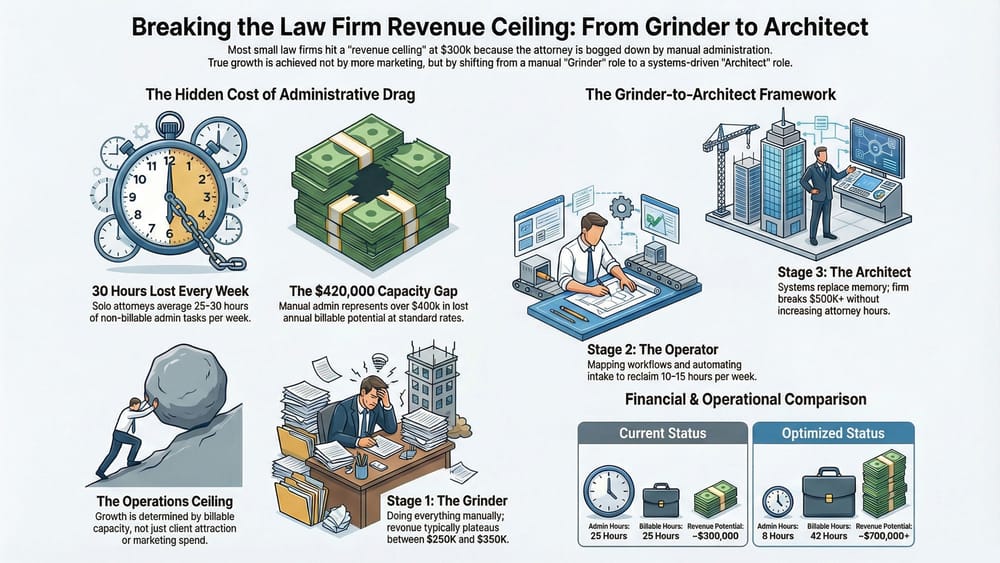
The firms stuck at $300K for three years and the firms that just crossed $500K are not doing different marketing. They're running different operations.
Every week, I talk to solo attorneys who are working harder than ever — 50, 60, sometimes 70 hours — and still watching their revenue flatline. They assume the same thing: “I need more clients.” But when we dig into the numbers, the truth is always the same.
They don’t have a marketing problem.
They have an operations ceiling.
And that ceiling is invisible until you know where to look.
If you’ve ever wondered why your law firm is not growing, even though you’re billing more hours, taking more calls, and pushing harder than ever, this post is the operational diagnosis you’ve never been given.
Because law firm growth isn’t determined by how many clients you attract.
It’s determined by how many hours you lose before you ever get the chance to bill them.
This post gives you the blueprint:
- What the growth ceiling actually is
- Why solo law firm operations break at the same revenue number
- The framework that separates plateaued firms from scaling firms
- Real examples from real attorneys
- A step‑by‑step plan to break the ceiling
- And the math behind the bottleneck you can’t see yet
Let’s get into it.
What Is Law Firm Growth — Really?
Law firm growth is defined as the increase in a firm’s billable capacity that converts into predictable, repeatable revenue. It is not simply “more clients,” “more marketing,” or “more hours worked.” True growth happens when the firm’s operational bottlenecks shrink while its billable output expands without requiring the attorney to work more.
For solo attorneys, law firm growth means one thing in practice:
Your systems produce more billable hours than your personal effort can.
What it is not:
- Not hiring more staff before fixing the workflow
- Not buying more software and hoping it solves the problem
- Not spending more on marketing to “fix” a capacity issue
- Not working more hours to brute‑force your way through the ceiling
What it is:
A structural shift from a practice that depends on you to a practice that is built to grow without you doing more.
This is where most attorneys misdiagnose the problem — and why the ceiling never moves.
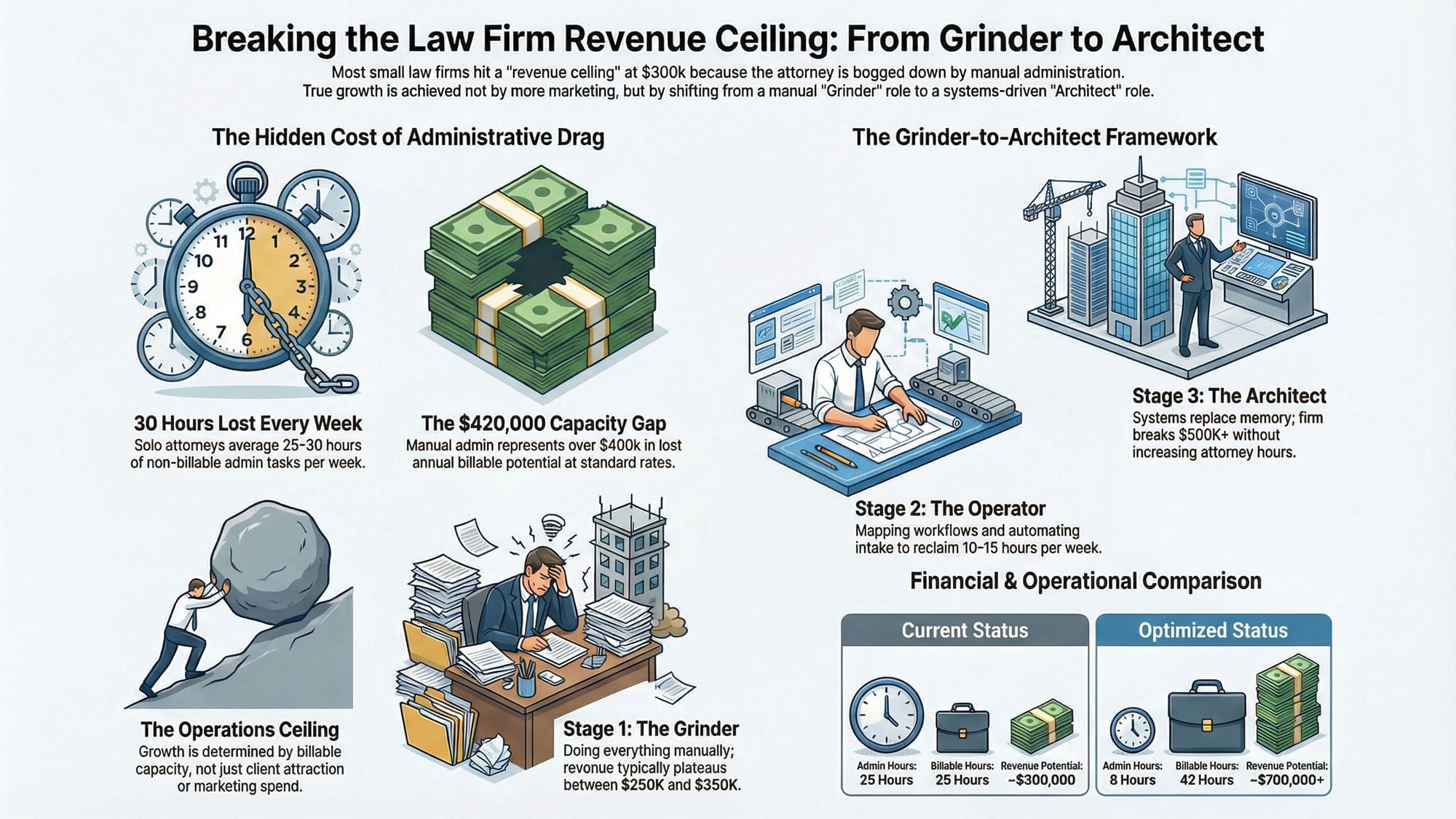
My Grinder‑to‑Architect Framework — The Blueprint for Breaking the Revenue Ceiling
Every plateaued solo attorney is stuck in the same transformation gap. They’re operating as the Grinder — the person doing everything — when the firm requires them to become the Architect — the person designing the system that does the work.
The Grinder-to-Architect Framework is the operating system that moves a firm from “I’m drowning” to “the practice runs without me.” It solves the core problem behind stalled law firm growth: lost billable capacity caused by operational drag.
Below is the full breakdown.
Stage 1 — The Grinder (The Hidden Revenue Leak)
The Grinder is the attorney doing everything: intake, scheduling, follow‑ups, billing, document prep, client updates, and the legal work itself. In this stage, the attorney loses 25–35 hours per week to non‑billable admin — hours that never convert into revenue.
Operational bottlenecks at this stage include:
- 48–72 hour intake response times
- Billing done “when I get to it”
- Client updates done reactively
- No standardized workflows
- No automation supporting the practice
A Grinder‑run practice maxes out at $250K–$350K in annual revenue — not because of skill, but because the attorney’s billable capacity is capped by administrative drag.
This is the revenue ceiling almost every solo attorney hits.
Stage 2 — The Operator (The First Break in the Ceiling)
The Operator begins to see the pattern: the problem isn’t marketing, clients, or effort — it’s the structure of the practice. This is where the attorney starts mapping workflows, identifying bottlenecks, and removing tasks that don’t require a law degree.
Key shifts include:
- Intake response time drops from 48 hours to under 5 minutes
- Billing becomes automated and predictable
- Client communication follows a standardized cadence
- Scheduling becomes self‑serve
- The attorney begins reclaiming 10–15 hours per week
This stage often pushes firms from $300K to $450K+ without increasing hours worked.
Stage 3 — The Architect (The Scalable Practice)
The Architect designs the practice to run without their constant involvement. Systems replace memory. Automations replace repetitive tasks. Workflows replace improvisation.
Architect‑level firms have:
- Automated intake, scheduling, billing, and follow‑ups
- A documented practice architecture
- A predictable weekly rhythm
- A clear separation between legal work and operational work
- A compounding automation flywheel that increases capacity every quarter
This is where firms break $500K, $600K, and beyond — not because they hired more people, but because they removed the bottlenecks that were suffocating growth.
The Financial Translation (The Math Behind the Ceiling)
Let’s run the numbers.
A solo attorney working 50 hours per week typically loses:
- 25–30 hours to admin
- 20–25 hours to billable work
At a $350/hour rate, those lost admin hours represent:
25 hours x 48 weeks x $350 = $420,000 in lost annual billable capacity
Even if only 20–30% of that converts into actual revenue, that’s $84,000–$126,000 left on the table every year.
This is the real reason law firm growth stalls.
Not marketing.
Not clients.
Not effort.
Capacity.
What This Looks Like in Practice
Example 1 — The $300K Plateau (Before/After)
A solo family law attorney came to me after three years stuck between $280K and $310K. She assumed she needed a marketing firm. She didn’t.
Before:
- 27 hours/week lost to intake, scheduling, billing, and client updates
- Intake response time: 36–72 hours
- Billing done monthly (sometimes bi‑monthly)
- 2–3 clients per month lost to slow follow‑up
- Working 55–60 hours/week
After implementing the Grinder-to-Architect Framework:
- Intake response time: under 5 minutes
- Billing automated weekly
- Client updates standardized
- Admin hours dropped from 27 to 9 per week
- Reclaimed 18 billable hours/week
At $350/hour, that’s $327,600 in recovered annual billable capacity — without hiring anyone.
Her revenue jumped to $460K in 11 months.
Example 2 — The Operational Walkthrough (Real Workflow)
A 4‑attorney firm believed they needed to hire a fifth attorney to grow. They didn’t know how many hours they were losing to admin.
Here’s what their intake workflow looked like:
Before:
- Intake emails sat for 24–48 hours
- Paralegal manually scheduled consults
- Attorney manually sent follow‑ups
- No tracking of lost leads
- 30% of inquiries never converted
After:
- Automated intake form
- Instant confirmation + scheduling link
- Automated follow‑ups at 24 hours, 48 hours, and 7 days
- Dashboard tracking every lead
Conversion rate increased from 38% to 62%.
They didn’t need a fifth attorney.
They needed a system.
Example 3 — The Contrast (Two Attorneys, Same Hours)
Attorney A and Attorney B both work 50 hours/week.
Attorney A (Grinder):
- 25 hours admin
- 25 hours billable
- Revenue ceiling: ~$300K
Attorney B (Architect):
- 8 hours admin
- 42 hours billable
- Revenue potential: ~$700K+
Same hours.
Same clients.
Same practice area.
Different operations.
How to Break Your Law Firm Growth Ceiling — Step by Step
This is the implementation checklist that moves a firm from plateaued to scalable.
1. Map every operational task (30–45 minutes)
List every task you touch in a week: intake, scheduling, billing, follow‑ups, document prep, client updates. This becomes your operational blueprint.
2. Identify the bottlenecks costing you the most hours
Circle the tasks that consume 5+ hours/week. These are your growth killers.
3. Calculate your lost billable capacity
Multiply your lost admin hours by your hourly rate. This number is your real ceiling.
4. Standardize your intake workflow
Define exactly what happens from inquiry → consult → engagement. No improvisation.
5. Automate your intake response time
Set up instant responses, scheduling links, and follow‑up sequences. This alone recovers 5–10 hours/week.
6. Systematize your billing
Move to weekly automated billing. No more “I’ll get to it later.”
7. Create a client communication cadence
Weekly updates, automated reminders, and templated messages eliminate reactive communication.
8. Build your practice architecture
Document your workflows. This is the foundation for scaling.
9. Remove every task that doesn’t require a law degree
If it doesn’t require legal judgment, it shouldn’t be on your plate.
10. Implement My Grinder-to-Architect Framework
This is the transformation engine. It’s how you reclaim 15–20 hours/week.
11. Run the Law Firm Time Audit
This gives you the exact dollar amount your bottlenecks are costing you.
Start the free Law Firm Time Audit
If you want to calculate exactly what your operational bottlenecks are costing you annually, the Law Firm Time Audit does it in 15 minutes. It is free, it is specific to your practice, and the number it generates will tell you exactly where to focus first.
Frequently Asked Questions About Law Firm Growth
Why is my law firm not growing even though I'm working more hours than ever?
Your law firm isn’t growing because your billable capacity is capped by operational bottlenecks, not effort. Most solo attorneys lose 25–30 hours/week to admin tasks that never convert into revenue. Until those hours are reclaimed through systems, automation, and workflow design, working more hours only increases exhaustion — not revenue.
What is the biggest barrier to law firm growth for solo attorneys?
The biggest barrier is the revenue ceiling created by administrative drag. Intake delays, slow billing, inconsistent follow‑ups, and manual scheduling collectively erase tens of thousands of dollars in billable capacity every year.
Does hiring more staff fix a growth plateau?
Not usually. Hiring staff into a broken workflow increases cost without removing the bottleneck. Systems before staff — always. A $165K hire cannot fix a workflow problem.
How long does it take to break a law firm growth ceiling?
Most attorneys see measurable gains within 30 days once intake, billing, and communication systems are implemented. Full transformation through the Grinder-to-Architect Framework typically takes 90 days.
Can law firm automation work for small or solo practices?
Yes — in fact, it works best for solo and small firms because the attorney is the bottleneck. Automation handles the repetitive tasks so the attorney can focus on billable work.
What’s the ROI of fixing operational bottlenecks?
A solo attorney losing 25 hours/week to admin is losing $420,000 in annual billable capacity at a $350/hour rate. Even if only 20% converts, that’s an $84,000 return — far higher than any marketing spend.
How do I know if my growth problem is operations or marketing?
If your revenue hasn’t moved in 2–3 years despite working more hours, it’s operations. Marketing fills the pipeline. Operations determine whether the pipeline does anything.
Break Your Revenue Ceiling
If you want to calculate exactly what your operational bottlenecks are costing you annually, start with the free Law Firm Time Audit.

Find Out Exactly Where Your Firm Is Losing Time
The AI Readiness Blueprint identifies the specific workflow gaps costing your firm 10+ hours per week — before you spend a dollar on tools or implementation.
Get the Free Blueprint →Free. No commitment. Takes 20 minutes.